

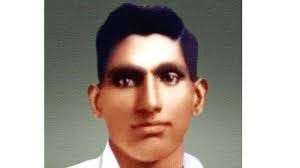
One of the most important events in the history of Kerala was the Vaikom Satyagraha that was held from 30 March 1924 to 23 November 1925, and fought for the rights of the lower castes to enter temples.
The man who conceived this agitation, was a follower of the great reformer Narayana Guru, and hailing from the Ezhava community, T. K. Madhavan, also known as Desabhimani Madhavan, a journalist, social reformer, inspired by Swami Vivekananda and the Bhagavad Geeta.
He was born on September 2, 1885 at Karthikappally in Kerala’s Alappuzha district. His father Kesavan Channar belonged to the Alummoottil family, a powerful Ezhava household in Travancore, known for its wealth and reformist leanings. While his mother Ummini Amma belonged to Komalezhathu family, her brother, Komalezhathu Kunjupilla, was a member of the Sree Moolam Praja Sabha, Kerala’s early legislative council.
In 1917, Madhavan assumed control of Deshabhimani, a daily newspaper that became his platform for social awakening. He used its pages to challenge casteism , amplify the teachings of Narayana Guru, and mobilize public opinion around temple access.
His editorials were not mere commentary, they were calls to conscience, often invoking the Bhagavad Geeta’s ethos of universal dharma.
Elected to the Sree Moolam Praja Sabha in 1918, Madhavan stepped into a space historically reserved for the elite, and used it to speak for the masses. His maiden speech, delivered in place of his uncle Komalezhathu Kunjupillai Chekavar, was no ceremonial formality, it was a revolt by itself. The resolution he presented demanded temple entry and worship rights for all, cutting through centuries of cast based exclusion.
At the 1923 Kakinada session of the Indian National Congress, Madhavan moved a resolution for the eradication of untouchability, linking Kerala’s caste struggles to India’s freedom movement. This was a masterstroke, it reframed temple access as a nationalist imperative, not just a regional grievance. His collaboration with leaders like K. P. Kesava Menon and his earlier meeting with Gandhiji in 1921 laid the groundwork for Vaikom Satyagraha and beyond.
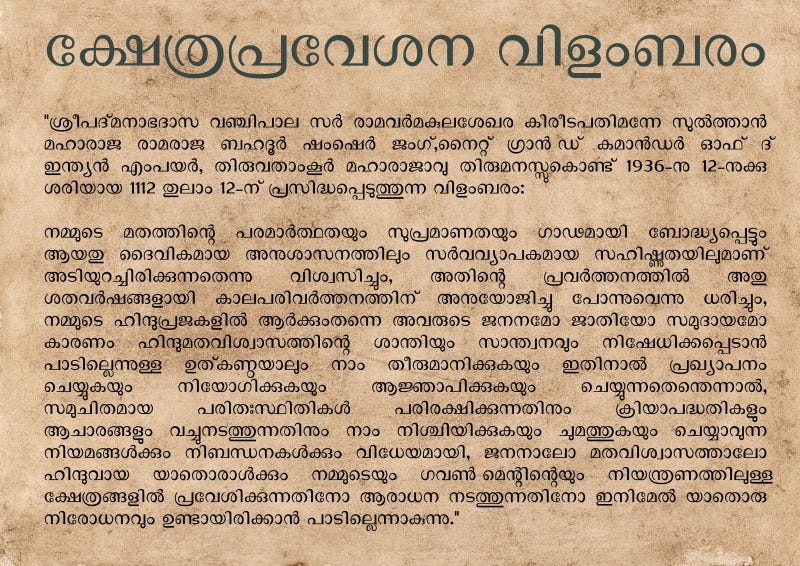
The Vaikom Satyagraha launched on March 30, 1924, demanded that all castes be allowed to walk on the roads surrounding the Vaikom Sree Mahadeva Temple, which had long been barred to “untouchables”. Led by T. K. Madhavan, K. Kelappan, and K. P. Kesava Menon, the satyagraha was deeply Gandhian in spirit, nonviolent, disciplined, and spiritually charged. Madhavan and Kesava Menon were arrested on April 7, 1924, but their imprisonment only intensified the movement’s momentum.
After Gandhiji’s intervention in March 1925, the Regent Maharani Sethu Lakshmi Bayi agreed to open the north, south, and west roads to all castes, but the eastern road and temple entry remained restricted.
The compromise was historic, but incomplete. Madhavan’s vision was not just access to roads, but access to divinity. The Temple Entry Proclamation of 1936, issued by the Maharaja of Travancore, finally fulfilled the deeper goal Madhavan had fought for.
By 1927, T. K. Madhavan had already stirred the conscience of Kerala through journalism, legislation, and satyagraha. His appointment as organizing secretary of the SNDP Yogam marked a shift from resistance to institutional renewal, a move that fused spiritual reform with grassroots mobilization.
The Sree Narayana Dharma Paripalana Yogam, founded in 1903 to propagate the teachings of Sree Narayana Guru, had become a beacon for social upliftment among the Ezhava community. Madhavan’s role as organizing secretary wasn’t just administrative, it was strategic and visionary, aimed at expanding the Yogam’s reach and deepening its reformist edge.
To energize the SNDP’s mission, Madhavan founded the Dharma Bhata Sangham, literally meaning “Soldiers of Dharma”.
This voluntary corps was designed to mobilize youth for social service and spiritual education, protect reformist activities from caste backlash and spread the teachings of Narayana Guru through disciplined outreach.
He also wrote the biography of Dr. Padmanabhan Palpu, the pioneering physician and social reformer who laid the ideological groundwork for the SNDP movement.
He saw in Dr. Palpu not only a mentor but a civilizational catalyst who had challenged caste barriers in both medicine and public life. By writing his biography, Madhavan, preserved Palpu’s legacy for future reformers and Yogam volunteers, framed Palpu’s life as a dharmic journey, from exclusion to empowerment and linked medical service to social justice, showing how healing extended beyond the body to the soul of society.
His passing away on 27 April 1930 marked the end of a life lived in fierce service to dharma, but the monuments that followed ensured his spirit remained woven into Kerala’s cultural and educational fabric.
The memorial at Chettikulangara, raised soon after his death, located near the famed Chettikulangara Devi Temple,it subtly links Madhavan’s reformist fire with the Shakti tradition, suggesting that true power lies in justice and inclusion.
The T K Madhavan Memorial College at Nangiarkulangara, founded 34 years after his death, stands as a living tribute to his belief in education as emancipation. It serves thousands of students, many from lower communities, fulfilling the very vision Madhavan fought for.
Shri T K Madhavan was a catalyst in massive social change in Travancore. Unlike the corrosive jati situation in neighboring Tamil Nadu (which has lasted to this day) the fact that he brought together all the different jatis in pointing out the unfairness of excluding some Hindus from temples