
Rajendra Chola 1

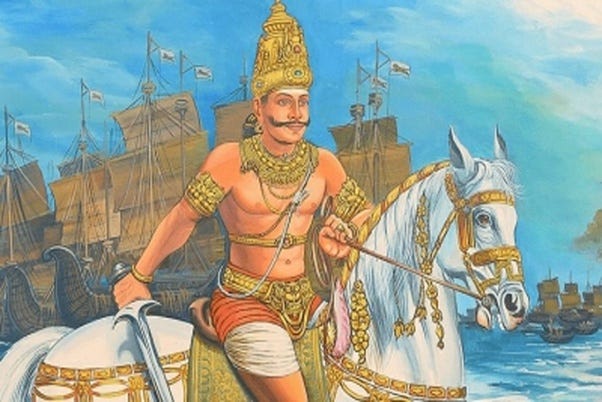
Rajendra Chola 1, the son of Raja Raja Chola 1, is considered to be one of the greatest emperors ever of the Chola dynasty. Under his reign, the Chola Empire extended all the way up to Ganga in the North, and became a true naval superpower going all the way up to South East Asia.
Early life
He was born around 971 CE, under the Thiruvathirai (Ardra) Nakshatra, his father the great Raja Raja Chola 1, and his mother Vanathi aka Thiripuvāna Mādēviyār. His brother Araiyan Rajarajan, would be a commanding general in Chola army.He was formally declared heir,and associated with his father Rajaraja I in the administration during the final years of his reign. In a sense the Cholas followed the dual kingship model, where they created a co-regent before succession, that made the process much more stable.
Early campaigns
His early campaigns beginning from 1002 CE, marked the decline of the Rashtrakutas as the Cholas consolidated in the Deccan. The strategically important region of Iddatur, the Krishna-Tungabhadra doab saw constant battles with the Western Chalukyas. Banavasi in North Western Mysore, fell to the Cholas, as their influence extended deep into the Deccan. And finally the capture of the Western Chalukya capital Manyakheta, affirmed their supremacy.
Rajendra commemorated his victories by erecting a Shiva temple at Bhatkal, blending conquest with devotion. He also captured Kollipakai in Telangana, as the Cholas pushed northwards into the Telugu speaking regions. These campaigns secured the empire’s northern frontiers, and capture of Raichur, Banvasi saw him gain access to fertile lands.
The Pandyas a long time rival was subdued in 1018 CE, as he expanded westwards into Kerala, defeating the Chera Perumals, gaining control over the maritime trade routes of the Arabian Sea. He appointed his son as viceroy with the title Jatavarman Sundara Chola Pandya, over the Pandya, Chera territories.
The Chalukya Wars
He fought many critical battles with the Chalukyas, starting out under his father’s reign in 992 CE. Rattapadi a strategic town, Banavasi an ancient cultural hub and Donur in Bijapur district, all fell marking the penetration of the Cholas right into the Deccan.
The Western Chalukya ruler Tailapa II was defeated at Annigeri, while his son Satyashraya faced defeat at Kogali effectively crippling the Western Chalukyas in the Deccan. Most of the treasures looted in the campaign were used to build the massive Brihadeeswara Temple at Thanjavur. The fort of Unkallu, was besieged and captured, in which the Chalukyan commander Lenka Keta was killed, as the Cholas consolidated their hold over the Deccan.
In 1015, Jayasimha II ascended the Western Chalukya throne, with the goal of recovering the territories lost by Satyashraya. He did gain ground initially as Rajendra was occupied with the Sri Lankan campaigns. However death of Vimaladitya of Vengi, saw an internal conflict break out between Vijayaditya VII, whom Jayasimha backed and Rajaraja Narendra, the son of Vimaladitya and Chola queen Kundavai.
Rajendra Chola intervened on behalf of his nephew, as his general Arayan Rajarajan defeated Vijayaditya’s forces. Raja Raja Narendra was placed on the throne, ensuring Chola dominance over Vengi and establishing themselves in Coastal Andhra.
Later at Maski in 1020 CE, Rajendra Chola himself led a massive army against Jayasimha II, and decisively defeated him. Gangavadi too was captured, as the Raichur doab came under the control of the Cholas.
The victory at Maski ensured that the Chola western frontier was secure, allowing Rajendra to focus on his northern expedition to the Ganges (1022 CE) soon after. By controlling Gangavadi and Raichur, Rajendra gained access to rich agricultural lands and trade routes, strengthening the economic base of the empire. The defeat of Jayasimha II reinforced the Chola dynasty’s reputation as the paramount power of South India.
Conquest of Anuradhapura
His commander Vallavaraiyan Vandiyadevan invaded Sri Lanka and sacked Anuradhapura, the ancient Sinhalese capital, whose fall marked it’s end as the political capital. The Cholas shifted the capital to Polonnaruwa, renaming it Jananathamangalam (a title of Rajaraja I). Tali Kumaran erected a Śiva temple called Rajarajeshvara at Mahatittha (modern Mantota, Mannar) and the town itself was named as Rajaraja Pura. The Chola occupied regions were collectively called as Mummudicholamandalam.
Control of Sri Lanka gave the Cholas access to pearls, elephants, and maritime trade routes in the Indian Ocean. By renaming cities and building temples, the Cholas asserted both political dominance and religious legitimacy. Sri Lanka was not treated as a temporary conquest—it was reorganized as a province of the Chola empire, with its own administrative identity.
While Rajaraja I, had annexed Anuradhapura, Rajendra launched further raids from Polonnaruwa into Rohana (Ruhuna), the southeastern province. By his fifth regnal year, Rajendra claimed to have completely conquered the island, incorporating both Anuradhapura and Rohana into the Chola Empire.
The Cholas controlled all of Anuradhapura and Rohana, effectively ruling the island. Polonnaruwa became the new Chola administrative center in the south. Rajendra’s expansion in Sri Lanka reached a point of diminishing returns—the costs of occupation outweighed the benefits.
The Gangaikonda Chola campaign
In 1019 CE, Rajendra Chola began what was his most ambitious campaign ever, the Gangaikonda Chola that saw him move towards the North. A campaign that saw him transition from a regional overlord to the emperor of the sub continent.
The campaign began in Kalinga, defeating King Indraratha of Somavamsi dynasty, gaining a gateway to the Gangetic belt. His other major triumph was over Mahipala, the Pala king of Bengal, a major blow to one of the powerful kingdoms in the East. He defeated Dharmapala, ending the Kamboja Pala dynasty, subdued Govindachandra as the Cholas entered deep into Bengal.
His march to the Ganga was not just military, it was civilizational. He brought back water from the Ganga to consecrate the new capital Gangaikonda Cholapuram, symbolizing Chola supremacy across India. By defeating multiple dynasties (Somavamsis, Palas, Kambojas, Chandras), Rajendra positioned the Cholas as the unrivaled power of the subcontinent.The campaign demonstrated logistical mastery, moving massive armies across diverse terrains, forging alliances, and sustaining long-distance raids.
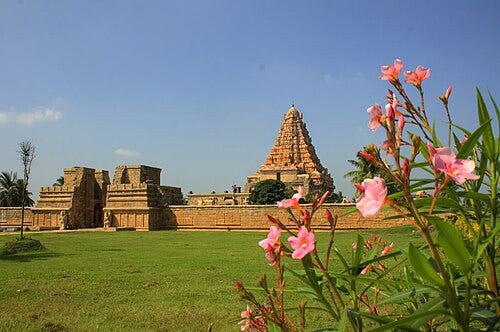
Rajendra commenced construction of Gangaikonda Cholapuram, envisioned as a rival to his father’s capital at Thanjavur, that had the massive temple, as well as the Chola Gangam Tank,a massive water reservoir, where the holy water from Ganga was ritually mixed. As per the Essalam Copper Plates, -the construction of the city, temple, and tank was somewhere in the Udaiyar Palaiyam region of Ariyalur district.
The Gangaikonda Cholaeswarer temple houses a form of Shiva known as Peruvudaiyar, with a huge lingam of 13 feet, and circumference of 20 feet.
South East Asia campaign
The kingdom of Srivijaya based in Palembang, Sumatra, ruled by the Sailendra dynasty, controlled maritime trade routes across the Strait of Malacca and the Indonesian archipelago. During the reign of Mara Vijayatungavarman, the kingdom had cordial ties with Raja Raja Chola 1, and a Buddhist monastery, Chudamani Vihara was built at Nagapattinam, symbolizing cultural and religious exchange.
However relations began to strain after Mara’s succesor Sangrama Vijayatunggavarman, ascended the throne. Suryavarman 1, the ambitious Khmer emperor, launched an attack on Tambralinga, a kingdom located on the Malaya peninsula. He sought Chola support, and in response Tambralinga took the support of Sangrama, leading to a multi point conflict. There was a religious angle with Khmer being a Shaivite kingdom, while both Srivijaya and Tambralinga were Buddhist.
Rajendra Chola launched a massive naval expedition in 1025 CE, striking at the heart of Srivijaya kingdom at Palembang, Sumatra. Sangrama was captured, and the Srivijayan monopoly over the shipping routes of the Gulf of Malacca was disrupted.
This campaign demonstrated the Cholas’ ability to dominate maritime Southeast Asia, securing control over the lucrative trade between India, China, and the Spice Islands. The ties strengthened with the Khmer empire, as the Cholas became the undisputed master of South East Asia.
Vallaipandur (Northeast Malaysia) and Kadarem (Northwest Malaysia, modern Kedah) were taken, as the Malayan Peninsula too came under Chola control. The fleet pressed further capturing Ilankasokam ( SE Thailand), Mathamalingam( Eastern Thailand) and Thalaitakkolam( Western Thailand) as the Cholas by now lorded over most of mainland South East Asia.
On the way back, the Chola fleet captured Manakkavaarem (Andaman & Nicobar Islands) and Magpapaalam ( Southern Myanmar), returning triumphantly to their homeland.
The massive Vijayamkonda Cholaeswarem Siva temple was built at Erumbur( Cuddalore dt) to commemorate this victory, now this temple is called the Kadambavanesvara temple. Rajendra assumed the title of Kadaremkondaan to signify his conquest of Kadaram( modern day Kedah, Malaysia) and one of his grandsons who led this expedition was given the title Kadremkonda Cholan.
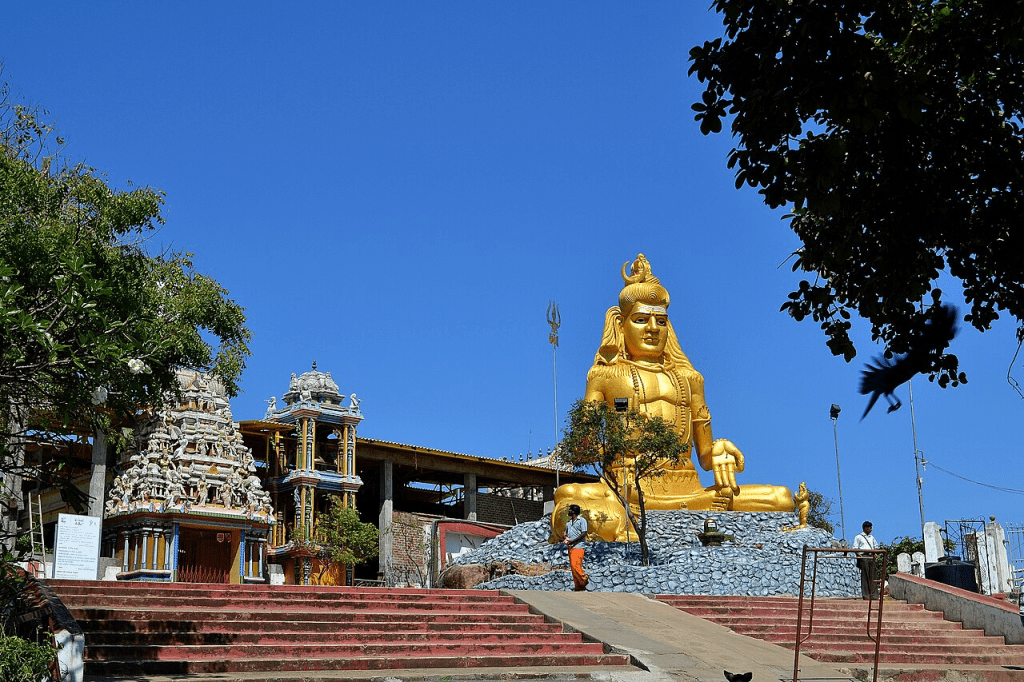
He also developed the Koneswaram Temple in Trincomalee, as well as the Pathirakali Amman Temple. He developed an efficient water management system that helped in irrigation and water supply.
Administration
He established a decentralized bureaucracy with autonomous assemblies called Nadu and Sabha managing local taxation, justice, and irrigation, ensuring efficient rule over vast territories from Ganga to Sumatra. He introduced the “Vellanvagai” land classification system, categorizing farmlands for precise revenue assessment based on fertility, which boosted agricultural surplus and funded naval fleets.
He patronized Tamil literature by granting villages to poets like Jayankondar, author of “Kalingattuparani,” an epic glorifying his Odisha campaigns, blending warfare with devotion. The Chola navy under him developed advanced shipbuilding at Nagapattinam port, using teak vessels with stern rudders, enabling sustained overseas trade in spices, horses, and elephants.
Rajendra minted pure gold “Kalana” coins featuring his tiger emblem, standardizing trade from Arabia to China and amassing wealth equivalent to modern billions through monopolies on pearls and conch shells. He engineered the Grand Anicut expansion and new canals linking Kaveri tributaries, irrigating 1,000+ villages and creating famine-resistant rice bowls that sustained a population boom.
how appropriate to write about emperor Rajendra chola on makara sankranti/pongal!
but have you seen his final resting place? not a massive monument. a shed. breaks one's heart.