

One of the most significant events of the freedom struggle was the Kakori conspiracy carried out on August 9th, 1925. It was the time the Hindustan Republican Association founded by Ram Prasad Bismil, was in dire need of funds for carrying out it’s objective of an armed revolution.
And that was the time, they came up with this conspiracy. Kakori was the station between Shahjahanpur and Lucknow through which the No 8 Down passed, carrying the money bags of the Treasury. Apart from getting the funds for the organization, it was also intended to get it noticed by the common people, and give a jolt to the British. The mastermind of the operation were Bismil and Ashfaqullah Khan.
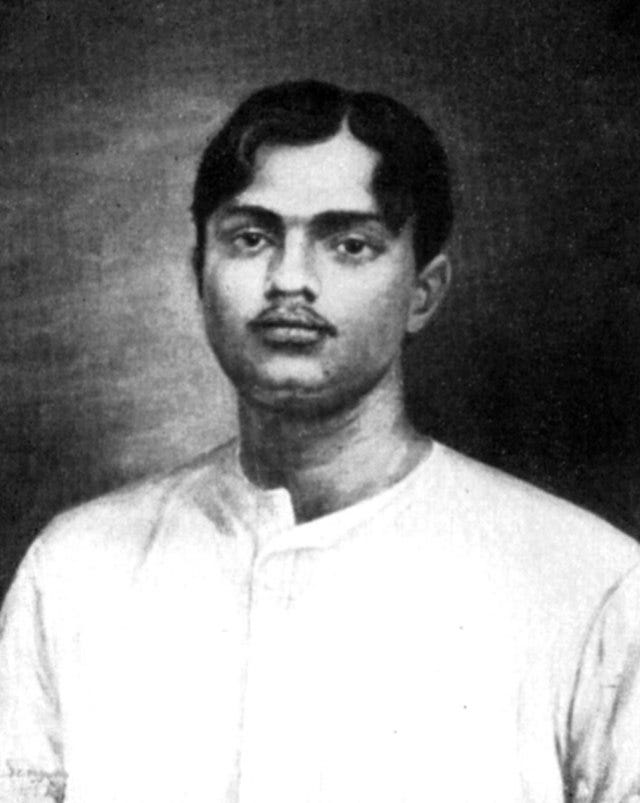
One of the main persons in that conspiracy was Rajendra Nath Lahiri, born on June 29, 1901 in the village of Mohanpur, Pabna district( now in Bangladesh) to Kshiti Mohan Lahiri and Basant Kumari. His father and uncle were imprisoned for their involvement in the banned Anushilan Samiti, which deeply influenced his patriotic upbringing.
At the age of 9, Lahiri moved to his maternal uncle’s home in Varanasi, where he grew up imbibing nationalist ideals. He studied primarily in Kashi (Varanasi) and later pursued M.A. in History at Banaras Hindu University (BHU). During this period, he met Sachindranath Sanyal, a prominent revolutionary and founder of the Hindustan Republican Association (HRA).
Recognizing his zeal, Sanyal appointed him as editor of magazine Banga Vaani as well as coordinator and arms-in-charge for the Varanasi branch of the Anushilan Samiti.
His reputation for discipline and courage earned him entry into the clandestine circles of the Hindustan Republican Association (HRA). These meetings were the crucible where strategies for armed resistance were forged. Out of devotion to his mother and love for Bengali literature, Lahiri established a small library.
He took charge of the Bengali Sahitya Parishad, fostering literary and cultural dialogue among students. This role positioned him as both a scholar and a revolutionary, bridging academia and activism.He also initiated the practice of handwritten letters among revolutionaries in Benares, that allowed them to articulate their ideals in their own words. His endeavor ensured that their voices were preserved authentically, resisting both censorship and erasure.
During the Kakori conspiracy, when Ashfaqullah Khan had his misgivings, fearing the robbery would expose the revolutionaries to harsh reprisals, it was Lahiri, who stood firm, arguing that bold action was necessary to inspire the masses and sustain the movement, that ultimately made Ashfaq reconsider.
Again at Kakori Railway Station, it was Lahiri who pulled the train’s emergency chain, setting into motion the plan, as Bismil, Ashfaqullah, Chandrashekhar Azad, and 10 others stormed the train. They seized the bags of government money, striking a symbolic blow against colonial authority. As expected the British Raj went on a massive crackdown.
After the Kakori train robbery, Ram Prasad Bismil sent Lahiri to Bengal to master bomb-making techniques at Dakshineshwar, which would expand the revolution’s reach. Lahiri succesfully gathered the material for bomb making, however a rather careless mistake by another revolutionary caused a premature explosion.
The blast alerted the police, leading to Lahiri’s arrest along with nine others. Initially sentenced to 10 years in prison for the Dakshineshwar incident, he was later tried for the Kakori conspiracy, when the British Govt decided to reopen the case to crush HRA. Lahiri along with other revolutionaries was accused of waging war against the Crown and looting the treasury, using fabricated documents and false witnesses in a rather farcical trial.
Lahiri was transferred to Lucknow Jail, where he awaited the outcome of the Kakori trial. Despite the stacked deck, he remained defiant, embodying the spirit of resistance. His writings and letters from prison reflected his unwavering belief in India’s freedom.
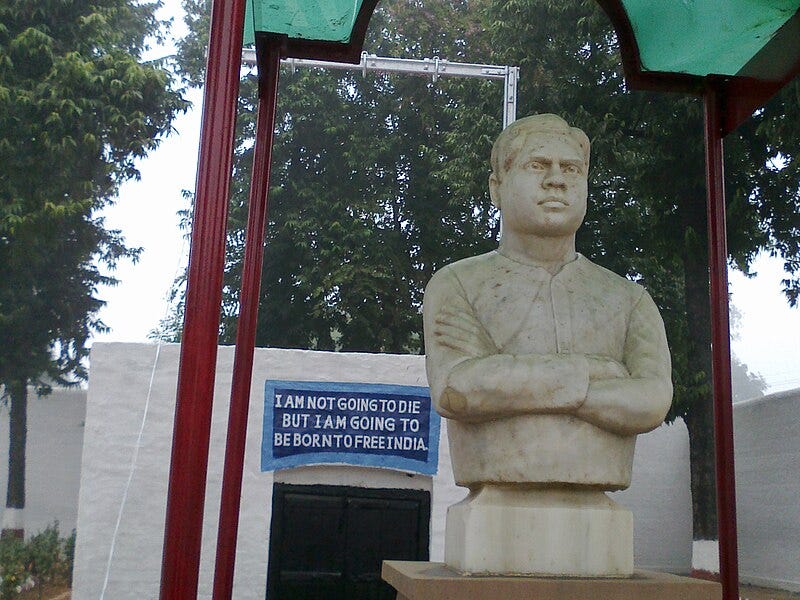
December 17, 1927
The day he was to be hanged, Rajendranath Lahiri was doing his usual exercises in the morning. When the jailor asked him, why he was doing so even on his last day, Lahiri replied.
Jailor Saab, I am a Hindu, I believe in rebirth. I want to be born with a physically fit body in my next birth, so that I can complete my unfinished tasks. Today is the most glorious day of my life, how can I forgo my daily routine. I am not dying, but I shall once again be reborn in a free India.
Rajendra Lahiri, went to the gallows with a smile on his lips, kissed the rope, shouted Vande Mataram .Another great son of Bharat, had given up his life for the country’s freedom.
Rajendra Lahirí’s sacrifice is observed every year on December 17 as Lahiri Diwas, in Gonda district. Cultural activities are observed in Gonda district jail in his honor and a yagna is conducted in front of his statue there. There is also a memorial in his honor there.