

A Telugu wedding (Telugu Vivāha Vēḍuka) is one of the most vibrant and deeply traditional ceremonies in South India, especially among communities in Andhra Pradesh and Telangana. It blends sacred Vedic rituals with cultural symbolism, creating a celebration full of joy, devotion, and family bonds.
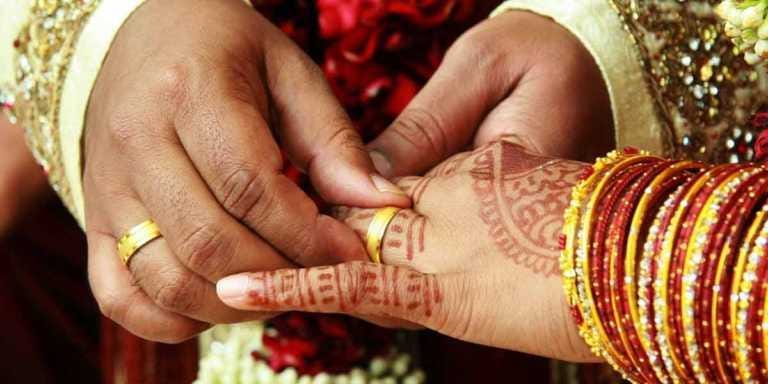
Nischithartham or engagement is the first step, where the muhurtam( auspicious date and time) is decided for the wedding. Generally months of Ashadam, Bhadrapada and Shunya maasam are considered inauspicious. Exchange of gifts takes place between the families of bride and groom, as well as rings.
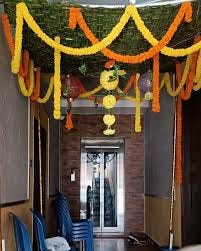
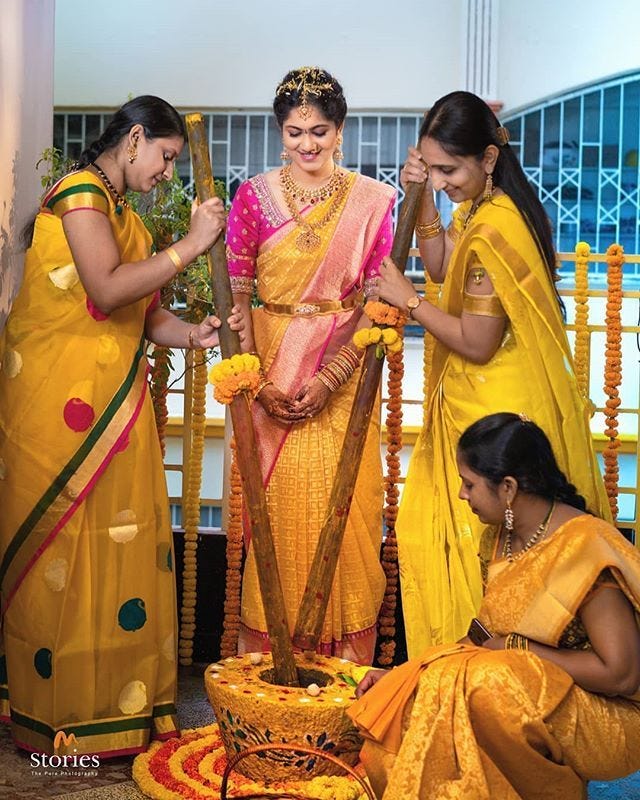
We then have the Pandiri Raatam ceremony, where the Pandiri( Pandal) is set up at both bride and groom’s home, followed by Pasupu Danchadam( Haldi ceremony) where ladies gather and pound the Pasupu( Haldi).
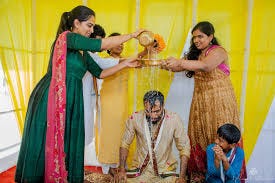
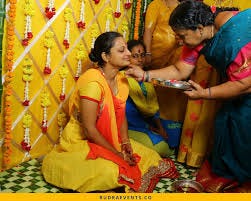
Next ceremony is getting the Pellikoothuru( Bride) and Pellikoduku( Groom) ready for marriage, which typically happens 1-2 days before the actual wedding. Both of them are given a Nalugu snanam(bath) which is basically a mixture of turmeric, oil and flour. Both the bride and groom, have a Thodu Pellikuthuru, Thodu Pellikoduku usually the youngest brother , sister or cousins, who also receive the same.
The bath is called as Mangala Snanam( Auspicious Bath) followed by a Mangala Harathi to both bride and groom at their respective homes. This ritual is followed on wedding day too, and both bride and groom receive a new set of clothing to wear.
Just before the wedding, the bride does Gauri Pooja at her home, this also contains the Pravara, a ritual where the bride’s Gotram is changed to that of the groom’s gotram.
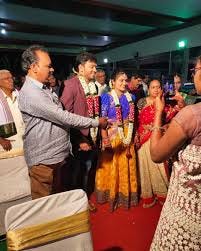
Edurukolu is what begins the wedding, where the groom arrives with his family to the wedding venue and is welcomed by the bride’s family. Typically the bride’s brother or cousin brother, washes the groom’s feet here.
There is also the Kashi Yatra ceremony, where the groom pretends to renounce the world, and leave for Kashi, then the bride’s brother or cousin stops him, and requests him to take up the Grihastha responsibility.
The groom then performs a Ganesh Puja at the mandapam, to remove any obstacles. In fact most wedding invitations in Telugu marriages would have a Ganesha on it by default.
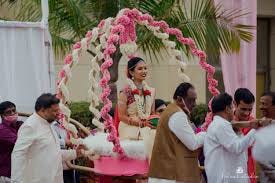
The bride is then escorted to the mandapam usually by her maternal uncle and aunt, who walk along with her. In some marriages, they follow an older custom, where the bride’s brothers, maternal uncles carry her in a basket. Nowadays though many weddings have the bride being carried to mandapam in a pallaki.
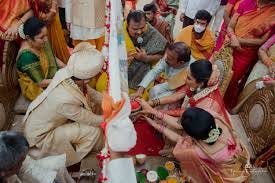
The bride and groom are initially separated by a Terasala(curtain), the first part is the Kanyadanam, where parents of the bride, wash the groom’s feet, basically the groom is believed to personify Vishnu himself, and bride is Lakshmi.
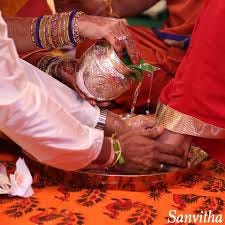
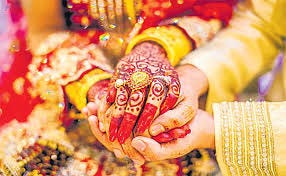
We then have the Panigrahanam where groom holds the hand of the bride, and is made to chant Dharmēca, Arthēca, Kamēcha, Mokshēca Nāti Carāmi thrice and assure the bride’s father he would always be there for her.
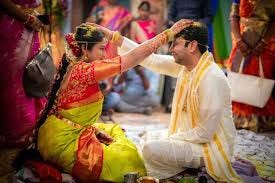
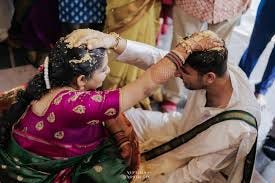
And the main part, Jilekkara Bellam, where a paste of Jeelakarra(cumin seeds) and Bellam( Jaggery) wrapped in Tambulam( Betel leaves), is placed on each other’s heads by both bride and groom. This is the exact muhurtam time, when the curtain is removed, and both bride and groom become one. And all those attending the wedding shower Akshintalu on the couple blessing them.
Madhuparkam ritual is where the bride now dresses up in a white saree with red border, while groom wears a white dhoti with red border. Both of them return to mandapam and now sit beside each other.
The Mangalasutra Dharana follows where the groom ties the Mangalasutra with 3 knots around the bride’s neck, signifying acceptance of her Manasa( Thought), Vaacha( Words) and Karmana( Actions). And this signifies the couple is one now in all ways.
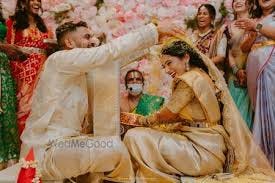
Talambralu the most fun part of the wedding, where both bride and groom shower each other with rice mixed with Haldi. This is generally considered an ice breaker, where both bride and groom, come close, removing any inhibitions. After this both of them exchange Dandalu( Garlands) accepting each other as life partners.
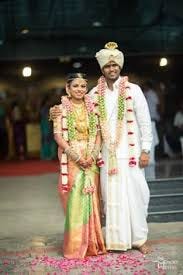
Brahma Mudi is conducted by knotting in betel nuts, dried dates, turmeric twig, betel leaf and coins loosely to the bride's pallu (saree end) and groom's Kanḍuva (scarf end) indicating they should maintain good relations with each other’s families.
Saptapadi is where bride and groom walk seven steps around the Homam, taking oaths to care for each other, grow together, share joys and sorrows, preserve wealth, to care for children, remain lifelong friends. The marriage is now complete as per Vedic scriptures.
Sthālīpākaṃ ritual is where the groom adorns the bride’s feet with silver mattelu( toe rings) and this symbolizes she is a married woman along with the nalla pusalu.
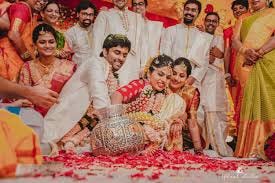
Then we have a ritual where a silver pot full of water is placed in front of the bride and groom, and a ring is put in it.The groom puts his right hand in and the bride puts her left hand in and they fish for the ring. They do this three times and whoever wins more often is supposed to be the dominant one in the marriage. Again this is a more fun event.
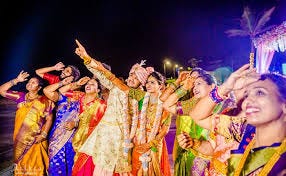
And then the bride and groom are shown the stars representing Arundhati and Vashista, representing the ideal couple.
And finally the Appagintalu ceremony, where the bride’s parents hand over her to the groom and family.
Basically after this the bride is then welcomed in her new home, where she is asked by her mother in law to gently push a small vessel of rice with her right leg, after receiving the harathi, as she enters her new home, followed by the Satyanarayana Vratam.