
Ugadi

Ugadi is celebrated as the New Year by Telugus and Kannadigas, and its very name carries deep meaning. It comes from the Sanskrit words Yuga (era, age) and Adi (beginning), symbolizing the dawn of a new era. Traditionally, Ugadi marks the onset of Chaitra masa (the first month in the Hindu lunar calendar), usually falling in March or April.
The festival is rich with symbolism:
Neem and jaggery in the Ugadi Pachadi represent life’s blend of bitter and sweet experiences.
It’s tied to the astronomical transition, marking the spring equinox and the renewal of nature.
Culturally, it’s a time for poetry recitals (Kavi Sammelanams), new resolutions, and honoring heritage.
The 60-year Hindu calendar cycle (Ṣaṣṭi Samvatsara) is deeply symbolic, each year name, from Prabhava to Akshaya, carries spiritual, astrological, and cultural significance, often linked to qualities, cosmic energies, or mythological associations rather than random labels. The cycle reflects Jupiter’s movement through the zodiac and is said to embody Lord Brahma’s creative time cycles.
Lord Brahma is said to embody the Samvatsaras, making the cycle a divine measure of time. The names often derive from Vedic deities, sages, or qualities (e.g., Angirasa from the sage Angirasa, Prajāpati from the creator god).
The cycle reflects life’s journey: from Prabhava (birth/creation) through stages of growth, struggle, joy, and wisdom, culminating in Akshaya (imperishable legacy).In astrology, each year influences human destiny, societal trends, and natural events, much like zodiac signs.
The story of the sixty years in the Hindu calendar cycle is wrapped in myth and symbolism, and one of the most evocative legends connects them to Narada.
Narada, the celestial sage, was known for his devotion but also for his pride. When his arrogance grew too great, Lord Vishnu decided to humble him. Vishnu transformed Narada into a woman, and in this form Narada married a king. From this union, sixty sons were born. Their lives, however, ended tragically.they all perished in battle. Narada, restored to his original form, was heartbroken at the loss of his children.
It was then that Vishnu offered consolation. He told Narada that his sons would not be forgotten; instead, their names would be immortalized as the names of the sixty years in the Ṣaṣṭi Samvatsara cycle. In this way, each year from Prabhava to Akshaya carries the memory of Narada’s sons, blessed by Vishnu to live eternally in the rhythm of time.
The years and what they signify.
1) Prabhava- Yagnas will be conducted
2) Vibhava- People will live happily
3) Shukla- Bounteous harvest
4) Pramodyuta- Hapiness to all
5) Prajotpathi- Growth in all areas
6) Angirasa- Fortune will dawn on all
7) Srimukha- Abundance of resources
8) Bhava- High thinking
9) Yuva- Plentiful rains and harvest
10) Dhaatha- Relief from disease and pain.
11) Eeswara- Safety and health of people
12) Bahudhanya- Blessed with harvests and wealth
13) Pramadhi- Moderate rainfall
14) Vikrama- Farmers will have a bountiful harvest
15) Vrusha- Good monsoon
16) Chitrabhanu- Shall fetch good results in any work
17) Swabhanu-Health and Safety
18) Taarana- Abundant rains
19) Parthiva- Rise in wealth and prosperity
20) Vyaya- Excess, and unnecessary expenses.
21) Sarvajita- Hapiness, and plenty of rains
22) Sarvadhari- Everyone shall be well fed
23) Virodhi- Distress due to poor rainfall
24) Vikruthi- Terrible times
25) Khara- Normalcy returns after tough times.
26) Nandana- Hapiness to people
27) Vijaya- Victory over enemies
28) Jaya- Gains made and victories won
29) Manmadha- Relief from pain and diseases
30) Durmukhi- Inspite of troubles, shall be safe.
31) Hevalambi- People shall be happy
32) Vilambi- Everyone shall be well fed
33) Vikari- Ill health is foretold this year
34) Sarwari- Crop yield will be low
35) Plava- Abundant supply of water
36) Shubakrutha- Auspicious year for all
37) Shobakrutha- Brings in gains
38) Krodha- Brings forth anger
39) Viswavasu- Abundant wealth
40) Parabhava- Bitter experiences for many.
41) Plavanga- Abundant water to all
42) Keelaka- Bounteous harvest
43) Soumya- Work shall bring good results
44) Sadarana- Normal year
45) Virodhikrutha- Feeling of revolt in people
46) Paridhavi- Feeling of fear among people
47) Pramadhicha- Lot of unfortunate accidents
48) Ananda- Hapiness
49) Rakshasa- Hard feelings among people
50) Nala- Bounteous harvest.
51) Pingala- Work shall bring in modest results
52) Kalayukti- Results at the right time
53) Siddartha- Your efforts shall be succesful
54) Roudri- Minor problems will be faced
55) Durmathi- Normal rainfall
56) Dundubhi- People shall be safe
57) Rudirogdhari- Lot of accidents to be faced
58) Raktakshi- Many inauspicious events
59) Krodhana- Victories shall come
60) Akshaya- Endless fortune this year.
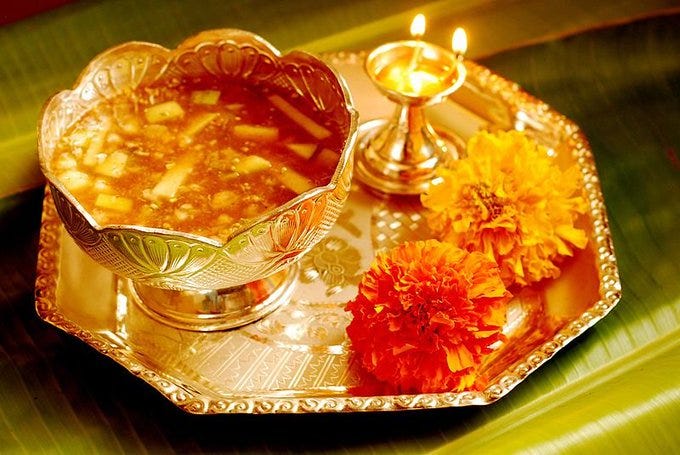
Ugadi Pachadi is one of the most profound symbols of the festival. It’s not just a dish, it’s a philosophy served in a bowl. Made with tamarind paste (sour), jaggery (sweet), neem flowers (bitter), salt, and raw mango (tangy), it embodies the Shadruchulu—the six flavors of life
Each taste represents a different emotion or experience one encounters through the year:
Neem flowers (bitter) → hardships, challenges, and lessons.
Jaggery (sweet) → joy, success, and happiness.
Tamarind (sour) → surprises, twists, and unexpected turns.
Salt (salty) → balance, stability, and the essence of life.
Raw mango (tangy) → excitement, new beginnings, and anticipation.
Chilli (spicy) → anger, passion, and intensity.
Together, these flavors remind us that life is never one-dimensional.it is a blend of sweet and bitter, joy and sorrow, calm and intensity. Ugadi Pachadi is eaten at the start of the year to prepare the mind and spirit for embracing all experiences with equanimity.
It’s a beautiful metaphor, just as the dish harmonizes contrasting tastes, life too becomes meaningful when we accept its contrasts.
Ugadi traditions beautifully weave together ritual, symbolism, and community. Like most festivals, homes are thoroughly cleaned to welcome freshness and purity. Dried mango leaves are strung across doorways as toranas—they symbolize prosperity, fertility, and the warding off of negativity. Families gather for prayers, invoking blessings for health, happiness, and abundance in the new year.
One of the most distinctive customs is the Panchanga Śravaṇam. Here, astrologers read aloud the Panchangam (almanac), foretelling the events, fortunes, and challenges of the coming year based on planetary positions and the year’s name in the 60-year cycle. It’s not just prediction,it’s guidance, offering people a framework to prepare themselves mentally and spiritually for what lies ahead.
Together with Ugadi Pachadi, these rituals remind people that life is a blend of contrasts, joy and sorrow, prosperity and struggle,and that renewal comes from embracing all of them with balance.